


Why Do Women Suffer From Back Pain More Often Than Men?
people visited their doctor in the Netherlands last year with back or neck complaints. More than a million of them were women.
- Women visit their doctor proportionally more often than men with back and neck complaints, across all age groups.
- In traditional Chinese medicine, your lower back is connected to the feeling of support: moral, emotional, financial and physical.
- Western science looks at fascia and the nervous system, and arrives at a similar point: tension only releases once your body feels safe enough.
- Yin Yoga works with time and stillness instead of force, giving your back the chance to relax on its own.
So you’re not the exception. What most people don’t know is that your back might be trying to tell you something that has nothing to do with lifting or sitting.
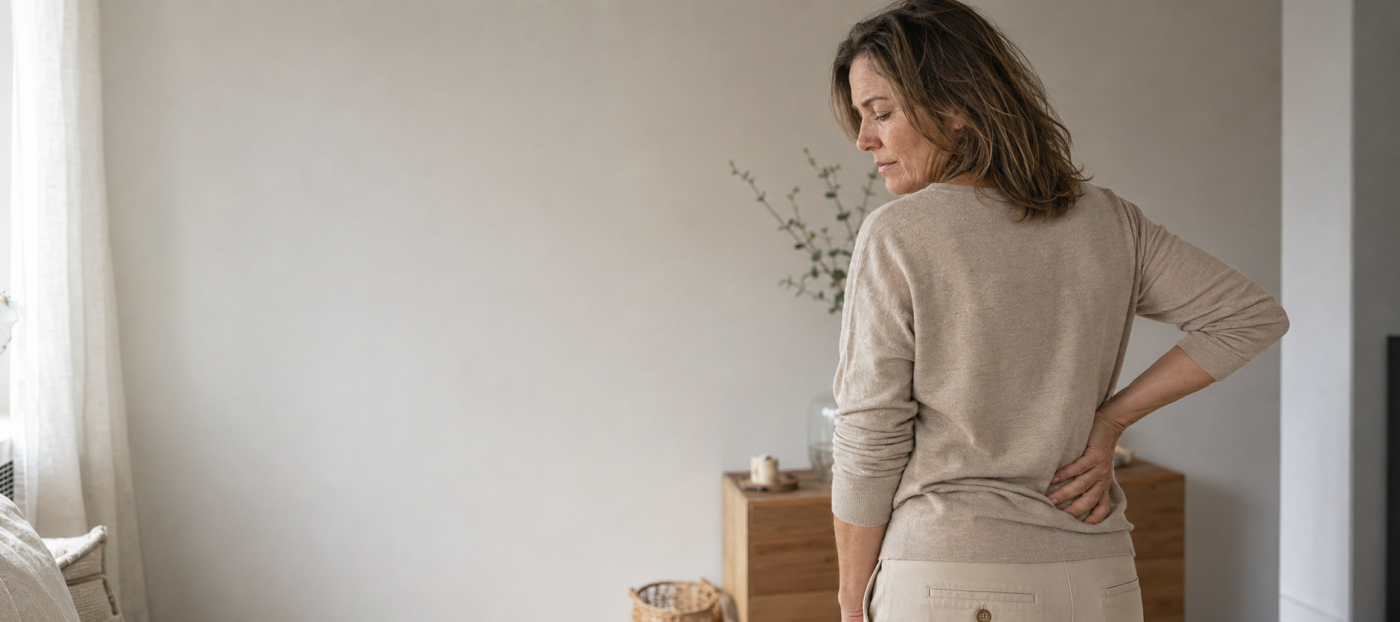
Maybe you think you simply have a weak back. Or that you should have worked harder on your core. Maybe you think it’s your office chair, or that one wrong movement from last week. Do you also recognise that feeling that your lower back speaks up especially on the days when so much else is already going on?
What Your Back Tells You About Support, According to Chinese Medicine
There’s an explanation for back pain that few people know, and it has nothing to do with posture or muscle strength. It comes from traditional Chinese medicine, a centuries-old framework that has never seen body and feeling as separate.
In this tradition, your lower back, together with your kidneys and bladder, belongs to what’s called the water element. That element is about rest, safety, foundational energy and the feeling of being carried. In other words: support.
Important to be clear: this isn’t a proven medical mechanism, but a traditional, experience-based framework. Still, it’s a question worth pausing on for a moment.
According to this view, your lower back speaks up especially when you experience too little support. And that’s rarely just about a mattress or an office chair.
Do you feel seen by the people around you?
Do you have somewhere to turn with what’s going on inside you?
Do you feel carried, or rather solely responsible for everything?
Do you sleep enough, move enough, allow yourself rest when your body asks for it?
This might be one of the reasons why women statistically visit their doctor more often with back complaints. Women often carry more of the invisible work: the mental planning at home, caring for others, the feeling that someone must always be able to lean on them. Giving support costs energy. If you get little back yourself from what you give away, it’s not so strange that the very place in your body that symbolises being carried is the first to speak up.
Honestly, researchers don’t know exactly why women suffer from back pain more often. Both the body and life circumstances probably play a role. What is clear: the difference is real, and it’s not down to chance or to who visits the doctor more often.
A small image that might help: your lower back is a bit like a subcontractor. It often gets handed the bill for work that isn’t finished somewhere else in your life.
Two Frameworks, One Conclusion
Two very different frameworks, ancient wisdom and modern science, that both arrive at the same point.
Back pain is rarely just a technical problem. It’s often a signal too.
And this is exactly where the added value of Yin Yoga for your back lies, different from active movement or deep stretching. In a Yin Yoga class, you move your spine consciously in multiple directions: forward folds, gentle twists, the occasional soft stretch. By staying still enough in a pose for long enough, the connective tissue around your spine gets time to relax, and your nervous system gets the chance to come out of that state of alertness. Not by pulling the tension away, but by giving your body the safety to let go of it itself.
The InnerPower Method: LAND • BREATHE • FEEL
In my work, I don’t call such a signal a problem to be solved, but a doorway. For that, I work with a fixed, recurring method that I call the InnerPower Method. It’s not a quick fix, but rather a method you can apply again every day, because it also brings you back to yourself every single time.
Letting the ground or the mat carry your weight, until you’re really standing somewhere again.
Letting your breath become softer, without steering it, so that space arises.
Honestly noticing what’s present in your body, even if that’s tension, instead of working around it.
Three Things You Can Try Today
Do you sit a lot? Stand up briefly every three quarters of an hour. Not to stretch, but to consciously exhale three times and feel your feet on the ground. For your nervous system, that’s often already enough to come out of a state of alertness for a moment.
In the evening, ask yourself honestly: in which area do I feel little support right now? Moral, emotional, financial or physical. You don’t have to solve anything with it. Simply naming it often already gives your body a bit more space.
Does the pain persist or get worse? Then a physiotherapist or doctor is the right next step. These insights are meant as support, not as a replacement for professional care.
Frequently Asked Questions About Back Pain and Yin Yoga
Why do women suffer from back pain more often than men?
Women visit their doctor proportionally more often with back and neck complaints, and that applies across all age groups. Researchers don’t know exactly why. Both the body and life circumstances likely play a role, and women also seek help for it slightly more often on average. What is clear: the difference is real and isn’t down to chance.
Can Yin Yoga help with a tense back?
Yin Yoga is not a treatment and doesn’t replace medical care. Many people do experience that lying still longer in a supported pose brings calm to their back. You move your spine consciously in multiple directions, instead of staying stuck in the same sitting posture all day. In doing so, your nervous system gets the chance to come out of a state of alertness. With persistent or worsening pain, a physiotherapist or doctor is the right next step.
How long should you hold a Yin Yoga pose?
In Yin Yoga, you usually stay in a pose for three to five minutes. Fascia, the connective tissue that runs through your entire body, only starts to respond after about a minute and a half of stillness. Shorter stretching therefore works differently. It’s not about going deeper, but about staying long enough without applying force.
What does back pain mean according to traditional Chinese medicine?
In this tradition, your lower back, together with your kidneys and bladder, belongs to the water element. That element is about rest, safety and the feeling of being carried. According to this view, your lower back speaks up especially when you experience little support, and that can be moral, emotional or financial support just as much as physical. This is a traditional, experience-based framework, not a proven medical mechanism.
Is Yin Yoga suitable if you already have pain now?
That depends on what your body can handle right now. Forward folds like the caterpillar can feel uncomfortable with radiating pain in your leg. If something feels sharp or tingling, come up gently and skip that pose for now. With persistent complaints, it’s best to consult a physiotherapist or doctor first.
Want to Experience This in Person?
Want to explore Yin Yoga, breath and nervous system regulation in person? Have a look at the upcoming sessions and retreats from House of InnerPower.
Sign up for the House of InnerPower newsletter and receive one meaningful welcome email to start.
Ilse-Marie Sobering is the founder of House of InnerPower and developer of the InnerPower Method: LAND • BREATHE • FEEL. She guides people in coming home to themselves, through Yin Yoga, Yoga Nidra, breathwork and nervous system regulation, with attention to fascia, body awareness and heart and brain coherence. Her work connects Eastern philosophy such as Taoism and Qigong with mindfulness, meditation and modern scientific insight, always translated into something you can apply in daily life.

Ilse-Marie Sobering is the founder of House of InnerPower and the creator of the InnerPower Method: LAND • ADEM • VOEL (Land, Breathe, Feel), a cyclical practice of returning to yourself again and again. She has studied yoga philosophy and Eastern philosophy for more than 25 years, and has worked professionally since 2015 as an E-RYT 500 yoga and Yoga Nidra teacher, mindfulness and breathwork coach, Ayurveda practitioner and EFT (Emotional Freedom Techniques) practitioner. In Spain, where she lived for seven years, she taught trainings, teacher trainings and retreats at various locations in the Málaga region, including near Periana, Nerja and Frigiliana. She now works from the Netherlands, teaching trainings and speaking in the Netherlands, in Spain and online. Within the method she works with Yin Yoga, Yoga Nidra, breathwork, meditation, Qigong and somatic work, complemented with elements from her hypnotherapy training. She teaches teacher trainings, continuing education and company training, for people living with long-term stress and for professionals who want to deepen the way they guide others.
