



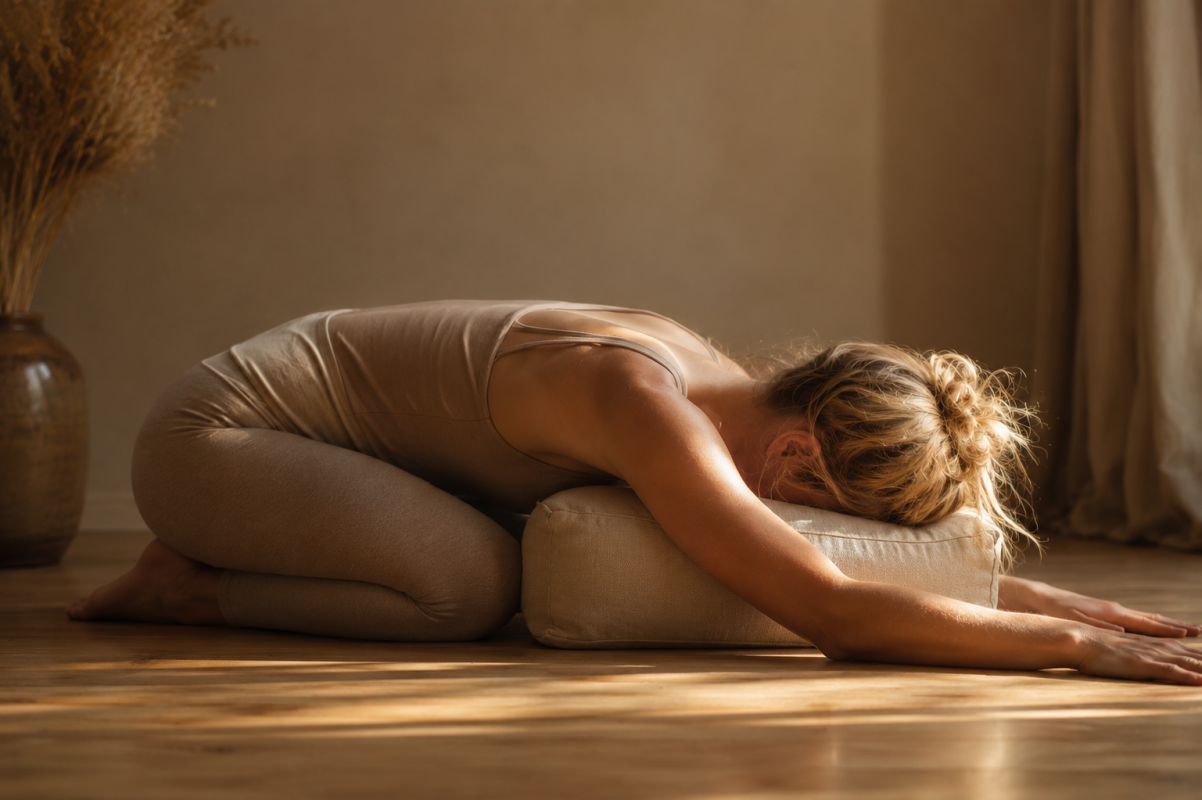
What was long dismissed as unimportant packing material turns out to be one of the most complex tissues in your body. And it changes how you look at Yin Yoga.
Did you know that in recent years, much more has become known about fascia? What was long treated as unimportant packing material in anatomy turns out to be one of the most complex and influential tissues in your body.
And the more we know about it, the clearer this becomes: if you want to understand how people actually live in their bodies, you can’t leave fascia out of the picture.
It’s one of the reasons I spend real time on it in the Yin Yoga Teacher Training. Not as dry theory. As living knowledge you find again in every pose you guide.
What is fascia?
Fascia is connective tissue. But that description doesn’t do it justice, because it sounds incidental. The reality is different.
Fascia is a three-dimensional network of collagen and elastin running through your entire body. It wraps your muscles, your organs, your bones, and your nerves. It connects everything to everything. If you stripped the body of everything except the fascial network, you’d still be left with a recognisable human shape. That’s how complete and consistent this tissue is.
In classical anatomy, fascia was cut away for decades to get to the “real” structures. That picture has fundamentally changed. Fascia contains proprioceptors and nociceptors: nerve endings that contribute to your sense of where you are in space, and to how you experience pain and tension. The tissue is active. It responds. It adapts.
The connection to your nervous system
Here it really gets interesting.
Fascia is saturated with nerve endings and is closely linked to the autonomic nervous system, the part of your nervous system that regulates your heart rate, your breathing, and your state of alertness. That connection isn’t a detail. It means what happens in your nervous system directly affects your fascial tissue.
With chronic stress or prolonged nervous system overactivation, tension in the body increases. Muscles stay shortened, breathing becomes shallower, and connective tissue structurally adapts to that ongoing state of alertness. The tissue becomes denser, less mobile, less permeable.
Researchers such as Bessel van der Kolk and Peter Levine convincingly describe how the body holds tension in nervous system patterns. Fascia, so closely interwoven with that nervous system, appears to be inseparable from it.
Whether fascia also “holds” stress and unprocessed experience in a deeper sense is something science and practice are still working out together. We don’t fully understand the mechanism yet, but what people experience during slow, deep poses, and what we know about the relationship between fascia and the autonomic nervous system, does point in that direction.
Why slowing down makes the difference
Fascia is viscoelastic. That sounds technical, but it describes something you probably already sense intuitively: this tissue behaves differently depending on how you approach it.
Movement is good for your fascia. It keeps the tissue supple and hydrated. But under slow, sustained pressure or stretch, something extra happens. The tissue adapts structurally in a way fast movement doesn’t reach. Researcher Robert Schleip describes this as the “creep response”: the tissue needs time to respond. Minutes, not seconds.
That’s exactly why Yin Yoga does what it does. In a Yin pose, you don’t stay for thirty seconds. You stay three, four, sometimes five minutes. Your muscles relax, and it’s right there, past the muscle layer, that you reach the connective tissue. The fascia around joints, along the spine, deep in the hips and pelvis. What fast movement simply doesn’t reach. The tissue needs time for that: sustained, gentle pressure that gives connective tissue the chance to take up fluid and adapt structurally. Not instead of other movement, but as an addition that does something fast movement simply can’t.
The body as one whole
What makes fascia so remarkable is its continuity. There are no real boundaries within the fascial network. Tension in the sole of your foot can run through to your calf, your hamstrings, your lower back. A chronic pattern in your shoulders echoes in how you breathe.
Your body isn’t built from separate parts that happen to sit next to each other. It’s one whole, connected by this tissue. That has direct implications for how you look at the body. A complaint somewhere local is rarely purely local. Fascia doesn’t think in segments. It thinks in lines, in networks, in patterns.
In Yin Yoga we consciously work with these fascial lines, choosing specific poses that address specific pathways through the body. Not randomly. With direction and insight.
Interoception: learning to listen to your body
Fascia also plays a role in interoception, your capacity to sense internal bodily signals. Warmth, pressure, tension, space. Sensations passed along through the fascial network and the nerve endings within it.
Interoception is the biological foundation of “being in your body.” People who live a lot in their heads, who struggle to feel what they feel, often have a weakened connection to these internal signals. Not because something’s wrong, but because they were never given the space to practise.
Yin Yoga trains that connection. Not by thinking about it extensively, but by creating the conditions in which the tissue gets room to say something. And you get the stillness to hear it.
Why this matters, whether you teach or not
Knowledge of fascia changes how you look at your own body. It puts words to something you may have sensed intuitively for years but couldn’t place. That spot that always stays tense. That feeling of being stuck that isn’t purely physical. The way rest sometimes goes deeper than relaxation.
Whether you work as a coach, therapist, or yoga teacher, or you’re simply someone who wants to deepen their own understanding, this knowledge makes a difference. For how you live in your own body. And if you guide others, for how you shape that guidance too.
Fascia isn’t a detail in anatomy. It’s the architecture of how your body holds together, moves, and feels.
Frequently asked questions
What is fascia, exactly?
Fascia is the connective tissue that wraps and connects your entire body like a web: muscles, organs, bones, nerves. It’s closely interwoven with your autonomic nervous system, the part that regulates your heart rate, breathing, and state of alertness. So what happens in your nervous system directly affects how your fascia feels.
Why does my body sometimes feel tight, even when I stretch a lot?
Under prolonged stress or nervous system overactivation, connective tissue becomes denser and less mobile. That’s not a matter of not stretching enough, but of a body stuck in a state of alertness. Yin Yoga therefore works with time and pressure instead of force, giving the tissue room to change.
What do you mean by interoception?
Interoception is your capacity to sense signals from inside: warmth, pressure, tension, space. Fascia plays a big role in this, since sensations are passed along via the fascial network. If you live a lot in your head, that connection is often somewhat weakened, not because something’s wrong, but because there’s rarely been space to practise.
How long do I need to hold a Yin Yoga pose before I notice something?
In Yin Yoga we work with poses of several minutes, because fascia responds more slowly than muscle tissue. There’s no fixed time that works for everyone. You sense from your own body when a pose has been enough, and that can differ from pose to pose.
This blog shares scientific insight and practical experience and is not medical or therapeutic advice. If complaints persist, it’s good to have someone assess your personal situation.
Stay in the loop
Join the House of InnerPower newsletter
Curious what else House of InnerPower offers? See our upcoming agenda, or sign up below and we’ll send you one welcome email with the essentials, nothing more unless you want it.

Ilse-Marie Sobering is the founder of House of InnerPower and the creator of the InnerPower Method: LAND • ADEM • VOEL (Land, Breathe, Feel), a cyclical practice of returning to yourself again and again. She has studied yoga philosophy and Eastern philosophy for more than 25 years, and has worked professionally since 2015 as an E-RYT 500 yoga and Yoga Nidra teacher, mindfulness and breathwork coach, Ayurveda practitioner and EFT (Emotional Freedom Techniques) practitioner. In Spain, where she lived for seven years, she taught trainings, teacher trainings and retreats at various locations in the Málaga region, including near Periana, Nerja and Frigiliana. She now works from the Netherlands, teaching trainings and speaking in the Netherlands, in Spain and online. Within the method she works with Yin Yoga, Yoga Nidra, breathwork, meditation, Qigong and somatic work, complemented with elements from her hypnotherapy training. She teaches teacher trainings, continuing education and company training, for people living with long-term stress and for professionals who want to deepen the way they guide others.
