



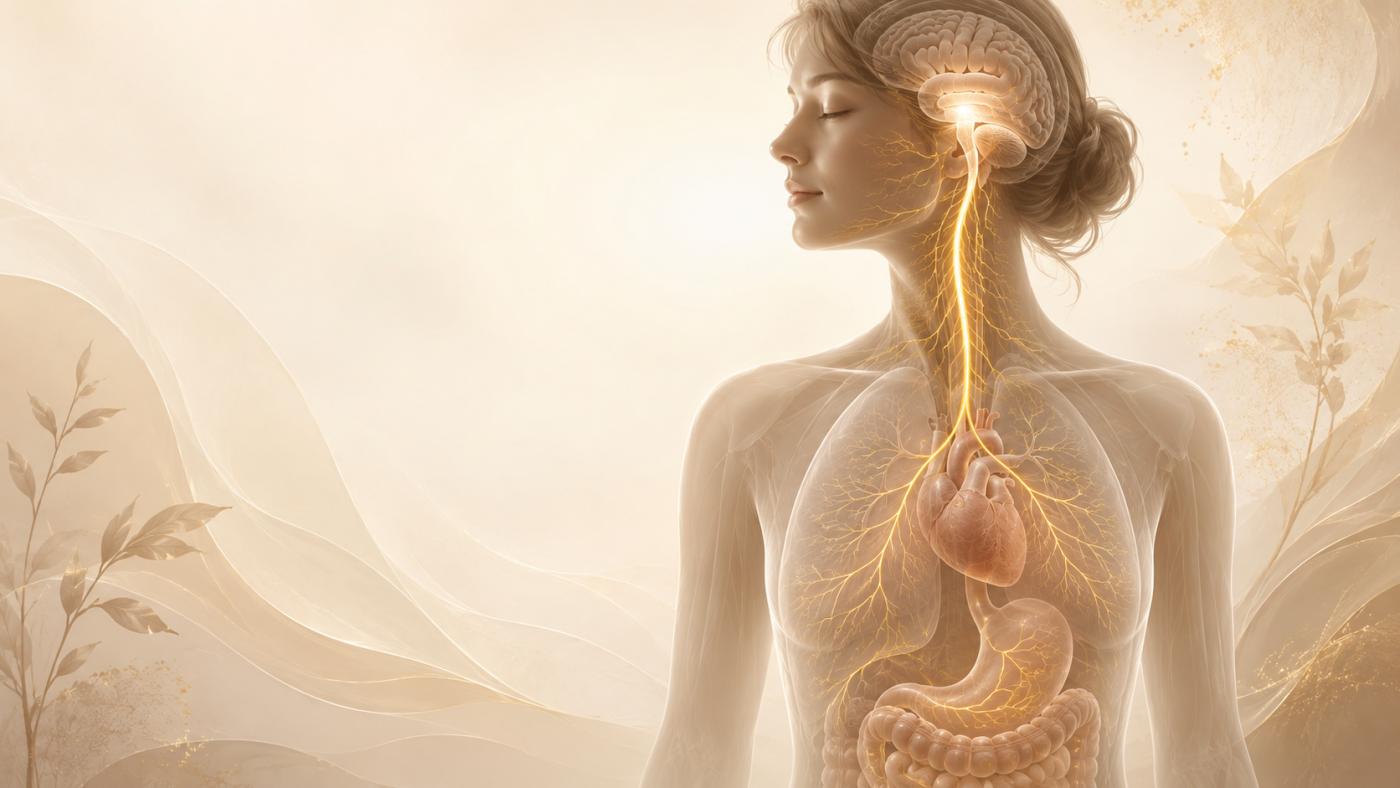
On the longest nerve in your body, what it knew before you did, and why humming sometimes does more than half an hour of meditation.
Your body often knows how you’re doing before you do. And it lets you feel that all day long, whether you’re listening or not.
Does this sound familiar? You’re in a conversation and before anything’s been said, your body already knows something’s off. Your shoulders rise, your breath grows shallow. Or you go to a party you were genuinely looking forward to, and for reasons you can’t explain, you just can’t settle.
How does this work? A nerve runs through your body that registers this kind of thing long before you have words for it. This nerve senses your heartbeat, your breath, your gut, the tension in your throat, and the expression on your face. And it sends all of that upward, to your brain, usually without you noticing.
This nerve is called the vagus nerve.
A wandering nerve
Vagus is Latin for wandering, and the name fits. The vagus nerve starts in your brainstem, runs past your throat and vocal cords, past your heart and lungs, through your diaphragm, and all the way into your gut. It’s the longest nerve in your autonomic nervous system, the part that works without you having to think about it.
A branch of the vagus nerve runs to your vocal cords. That’s why humming, singing, and chanting directly influence your nervous system.
So if you belt it out to the radio on a busy day and notice you feel a bit calmer afterward, that’s not your imagination. That’s the nerve joining in.
Your body talks back
Here’s something that surprises a lot of people. We tend to assume our brain is in charge and the body just carries out orders. With the vagus nerve, it’s largely the other way around. Most of the information travelling along this nerve goes upward: from your body to your brain, not the reverse.
Your body is constantly reporting. And your brain is listening.
Your gut holds more nerve cells than your spinal cord. The vagus nerve connects your head to this network, sometimes called your second brain. A gut feeling isn’t just a figure of speech. The butterflies of falling in love, the knot of tension, that’s your body passing something along in a language it already speaks, long before you’ve found the word.
This is exactly why simply thinking about calm doesn’t make you calm. You can’t reason your way into it.
Your body believes what it feels sooner than it believes what you think.
Safety is something you feel, not something you decide
Researcher Stephen Porges described how the vagus nerve relates to the feeling of safety. According to his polyvagal theory, your nervous system is constantly switching between states, mostly outside your awareness. On one side, alertness and tension. On the other, a state of calm, presence, and connection, linked to a specific branch of the vagus, the ventral vagus.
Worth knowing: polyvagal theory is a model, a way of looking at things. Not every part of it is equally well proven. But as a lens for understanding why you feel on edge around one person and naturally calmer around another, it’s surprisingly useful.
The muscles around your eyes and mouth are connected to this system. A genuine smile, where your eyes join in, sends a different signal into your body than a polite smile where only your mouth moves. Your body notices the difference. It’s often more honest than we are.
And then there’s yawning. Yawning during a Yin class is sometimes seen as a sign someone’s bored. In reality it’s often the opposite. Yawning appears to be linked to that same ventral system that signals your nervous system shifting back to rest. If you yawn as you finally slow down, that’s usually a good sign. Your body is letting go.
The vagal brake, and how to use it yourself
Porges calls the calming effect of the ventral vagus a brake. A vagal brake. Your nervous system can accelerate when needed, and slow down again once it’s safe enough. For many people who’ve lived on tension for a long time, that brake has grown a bit stiff. Not broken, just underused.
The good part is that you can practise that brake. And you need nothing but your breath. The key lies in your exhale. On the inhale, your heart rate speeds up slightly, on the exhale it slows. By consciously making your exhale longer than your inhale, you invite that vagal brake to do a bit more work.
The vagal brake exercise in three steps
Afterward, notice what’s changed for a moment. Maybe nothing big. Maybe just a bit more space in your chest, or a breath that’s naturally grown a little deeper.
Don’t do this exercise if you feel lightheaded, or if conscious breathwork stirs up unrest for you. With breathing, the rule always applies: your own pace, your own say. Calmer, not more forced.
LAND · BREATHE · FEEL
LAND, BREATHE, FEEL is the method I developed myself: not a quick fix, but a path you can return to for your whole life. When you work with it, as I do in my trainings and in my own practice, you see the vagus nerve showing up everywhere.
Whether Yin Yoga works precisely through the vagus or through the nervous system’s broader relaxation response isn’t always something science can trace down to the last nerve cell. What’s clear is this: working slowly, holding long, and taking the time to feel brings your body into a state where recovery becomes possible.
You don’t need to understand this nerve to benefit from it. You only need to give it the room to do its work. And that usually starts with one thing: exhaling slower than you’re used to.
Frequently asked questions
What exactly is the vagus nerve?
The vagus nerve is a long nerve that runs from your brainstem down past your heart, lungs, and gut. It constantly registers how your body is doing and sends that information back to your brain, often before you have words for it. That’s why you sometimes already feel that something’s wrong, or that you’re safe, without being able to explain why.
What is the vagal brake?
Porges calls the calming effect of the vagus nerve a brake: your nervous system can accelerate when needed, and slow down again once it feels safe enough. In people who’ve lived on tension for a long time, that brake has often grown a bit stiff. Not broken, just underused.
Can I train my vagus nerve myself?
You need nothing special, just your breath. On the inhale, your heart rate speeds up slightly, on the exhale it slows. By consciously making your exhale a bit longer than your inhale, you actively engage that vagal brake. It’s not a trick that works instantly, but something you develop a feel for through repetition.
Why do I sometimes yawn during a Yin Yoga class?
Yawning is sometimes seen as a sign of boredom, but it’s often the exact opposite. It’s linked to the system that signals your nervous system shifting back to rest. If you yawn as you finally slow down, your body is letting go. That’s a good sign.
This blog shares scientific insight and practical experience and is not medical or therapeutic advice. If complaints persist, it’s good to have someone assess your personal situation.
Ilse-Marie Sobering
Ilse-Marie Sobering is the founder of House of InnerPower and developer of the InnerPower Method: LAND • BREATHE • FEEL. She offers certified trainings in the Netherlands and Spain, working from a combination of Yin Yoga, breathwork, meditation, Yoga Nidra, nervous system regulation, fascia, embodiment, and Taoist wisdom. Her work brings people back to their bodies, so they can return to themselves again and again.
Stay in the loop
Join the House of InnerPower newsletter
Curious what else House of InnerPower offers? See our upcoming agenda, or sign up below and we’ll send you one welcome email with the essentials, nothing more unless you want it.

Ilse-Marie Sobering is the founder of House of InnerPower and the creator of the InnerPower Method: LAND • ADEM • VOEL (Land, Breathe, Feel), a cyclical practice of returning to yourself again and again. She has studied yoga philosophy and Eastern philosophy for more than 25 years, and has worked professionally since 2015 as an E-RYT 500 yoga and Yoga Nidra teacher, mindfulness and breathwork coach, Ayurveda practitioner and EFT (Emotional Freedom Techniques) practitioner. In Spain, where she lived for seven years, she taught trainings, teacher trainings and retreats at various locations in the Málaga region, including near Periana, Nerja and Frigiliana. She now works from the Netherlands, teaching trainings and speaking in the Netherlands, in Spain and online. Within the method she works with Yin Yoga, Yoga Nidra, breathwork, meditation, Qigong and somatic work, complemented with elements from her hypnotherapy training. She teaches teacher trainings, continuing education and company training, for people living with long-term stress and for professionals who want to deepen the way they guide others.
