


What Is Yin Yoga? On Stillness, Edges, and Coming Home to Your Body
By Ilse-Marie Sobering, House of InnerPower
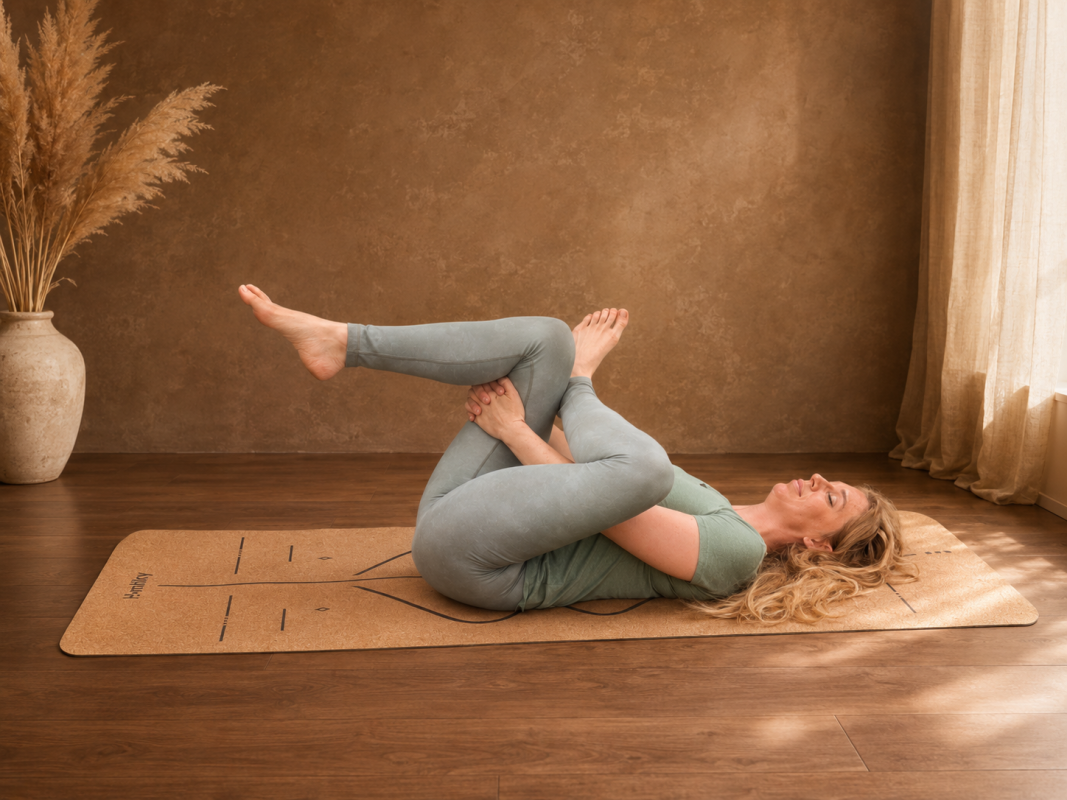
Yin Yoga is a slow, quiet form of yoga in which you hold seated or lying poses for three to five minutes, moving only to your first edge of resistance, never past it. Where most yoga styles work your muscles, Yin Yoga works your connective tissue: fascia, tendons, and joints. The result isn’t a workout, it’s an invitation to slow down. Below, I take you through what Yin Yoga actually is, why it does so much more than stretching, and how you can try it today.
The moment stillness feels unfamiliar
You might know the feeling. You settle into a yin pose and the first minute stretches on forever. Your body wants to move, your mind wants a task. Then, somewhere in minute two or three, something shifts. Your breath slows. You start noticing what’s actually happening in your body, without trying to change it. That uncomfortable beginning is exactly where Yin Yoga does its work.
What Yin Yoga actually is
Yin Yoga rests on three simple, but not always easy, rules:
- Move to your first edge of resistance, never further. Yin Yoga is not a stretching contest.
- Stay as still as possible. The muscles around the pose relax, so the connective tissue can do the work.
- Hold the pose for three to five minutes, sometimes longer.
Its philosophical roots lie in Taoism: the interplay of yin and yang chi, the cooling and warming life-energy present in everything around us. Yin represents the feminine, the hidden, the still, and the deep. Where yang-style movement and more active forms of yoga heat and energize the body, yin turns you inward and downward. That same principle, moving into action from stillness, wu wei, is also the philosophical foundation of the InnerPower Method.
Why Yin Yoga is more than stretching and relaxation
Yin Yoga reaches tissue that most active movement doesn’t touch: fascia, tendons, ligaments, and joints. Long, gentle loading keeps that tissue supple and resilient. But the effect isn’t only physical. Researchers at Lund University followed a group of stressed adults through five weeks of Yin Yoga practice, and found a clear drop in the stress hormone adrenomedullin, less anxiety, and better sleep, compared to a group that didn’t practice.1
That lines up with something central to the InnerPower Method: the nervous system needs time and safety to shift from alert back to calm. Stephen Porges’ polyvagal theory describes how your nervous system is constantly, mostly unconsciously, scanning whether an environment is safe. For many people, lying still in a pose without hurry is unusual enough to bring that question to the surface. Which is exactly why it matters.
Back to the body: LAND • BREATH • FEEL in a yin pose
A yin pose is a very concrete way to experience the InnerPower Method. LAND: notice where your body meets the ground, the mat, or a bolster, and let your weight really settle there. BREATH: follow your breathing without steering it, and notice how it naturally slows the longer you stay still. FEEL: what surfaces when there’s nothing to do? Discomfort, restlessness, a thought, an emotion. You don’t need to do anything with it, noticing it is already the practice.
A small step for today
You don’t need a class to feel what Yin Yoga does. Sit or lie down in a pose that already gives you a gentle stretch, for example legs up a wall with them slightly apart, or a soft butterfly pose. Set a timer for three minutes. Stay as still as you can and let your breath find its own pace. Notice what happens in the first minute, and what’s different by the third.
An invitation
For me, Yin Yoga is one of the most direct ways to teach people what it feels like to truly come home to their own body. Simple on the outside, rich on the inside. If you’d like to keep exploring this practice, join our newsletter below, we’ll let you know when new English-language offerings from House of InnerPower become available.
Frequently asked questions about Yin Yoga
Do I need yoga experience to start Yin Yoga?
No. Yin Yoga is especially accessible for people without any yoga experience, because the poses are passive and you find your own edge at your own pace.
Do I need to be flexible for Yin Yoga?
No, flexibility isn’t a requirement. Everyone experiences a pose differently, and props like a bolster or block let you adapt any pose to your own body.
How long do you hold a Yin Yoga pose?
Usually between three and five minutes, sometimes longer. That extended time is what allows the practice to reach the connective tissue rather than the muscles.
How is Yin Yoga different from other styles of yoga?
More active, yang-style yoga mainly works your muscles and warms the body. Yin Yoga instead works deeper connective tissue such as fascia, tendons, and joints, in stillness and with long hold times.
Are there downsides or things to watch out for with Yin Yoga?
Yin Yoga requires care if you have existing joint issues, hypermobility, or injuries. Always move to your first edge of resistance and no further, and check with a doctor or physiotherapist if you’re unsure. Yin Yoga complements medical care, it doesn’t replace it.
1. Daukantaitė, D., Tellhed, U., Maddux, R. E., Svensson, T., & Melander, O. (2018). Five-week yin yoga-based interventions decreased plasma adrenomedullin and increased psychological health in stressed adults: A randomized controlled trial. PLOS ONE.
Stay in the loop
Join the House of InnerPower newsletter
Curious what else House of InnerPower offers? See our upcoming agenda, or sign up below and we’ll send you one welcome email with the essentials, nothing more unless you want it.
